Insights
The 80% That Never Gets Written Down
Date
Author
Prashanth Ray
A surgeon walks out of a six-hour case. If you ask them what happened, what they decided, when they pivoted, what made them pause, they'll give you an account that feels complete. It probably isn't.
Research on expert decision-making puts conscious recall of intraoperative choices somewhere around 20%. The rest is automated expertise, pattern recognition so fast, so deeply embedded, it never surfaces as deliberate thought. The hands move. The case progresses. The choices are made. And then they're gone, because there was never a moment of conscious reasoning to anchor a memory to.
"The choices are made. And then they're gone because there was never a moment of conscious reasoning to anchor a memory to."
THE DOCUMENTATION GAP
This isn't a training problem or an attention problem. It's structural. Expert performance, in any domain, operates precisely because it doesn't require conscious effort. The automaticity is the expertise. But it creates a gap that has quietly undermined surgical training, patient safety research, and outcomes science for decades.
The op note is a legal document. It captures what was done, not how, not why, not the subtle adjustment before a critical moment, not the micro-decision that prevented a complication from becoming a crisis. Retrospective interviews attempt to reconstruct what was never consciously registered. Post-case surveys ask surgeons to remember things they were never fully aware of in the first place. The knowledge exists, it was exercised, just minutes ago but it cannot be recalled through reflection alone.
The result: surgical intelligence is almost entirely oral. It transfers through apprenticeship, through proximity, through years of watching the right people operate. That works, slowly. It doesn't scale. And it leaves enormous variation in outcomes that no one can systematically address because no one can see where the variation comes from.
WHAT REAL-TIME CAPTURE CHANGES
There are only a few ways to access surgical cognition as it actually happens. You need to be in the room. You need the right sensors. And you need to be capturing live, not in the hour after, not in the weekly M&M, not in the simulation lab. The data is perishable. Every minute after a case closes, the accessible signal degrades.
This is what Iris was designed around: a head-mounted 4K capture device that travels with the surgeon, recording the first-person view of a procedure from the moment the case begins. Not a fixed ceiling camera. Not a robotic scope. The surgeon's actual point-of-view, unobstructed, across open surgery where most of the complexity lives and almost none of the instrumented data currently exists.
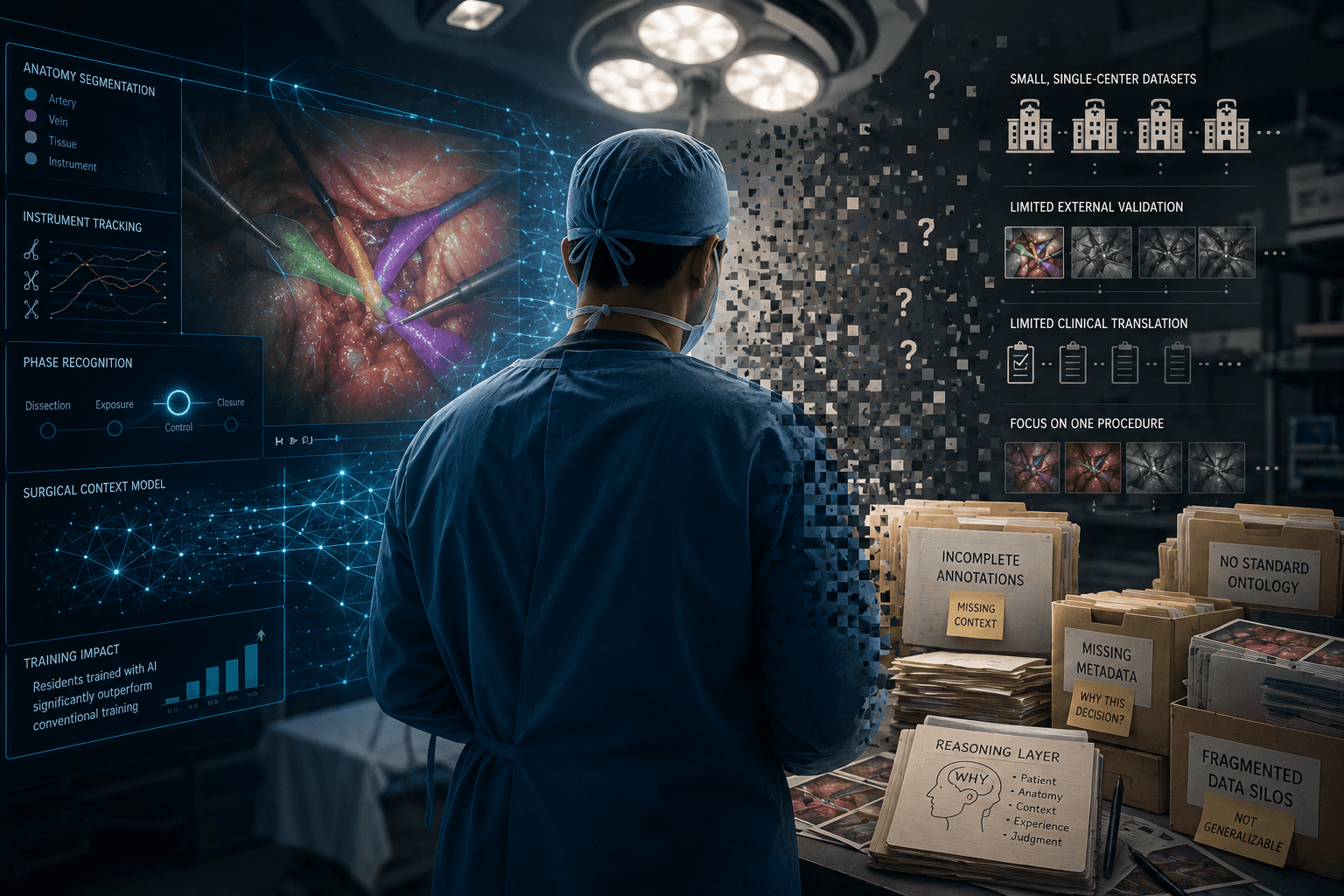
But capture alone is only the first step. Raw surgical footage is enormous, unstructured, and largely unsearchable. The second layer is what out cloud platform does structuring that footage into a usable intelligence layer. Phase annotation. Critical moment detection. A searchable, comparable archive of what actually happened across cases, across surgeons, across institutional settings.
WHAT THE DATA IS REVEALING
When you analyze surgical video at this level of granularity, the patterns that emerge aren't what most people expect. The gap between an expert and a competent surgeon isn't primarily about technique at a surface level, they often look similar. The differences show up in timing, in attention management, in how the operating field is maintained in the two minutes before a high-stakes moment rather than during it.
"The signal lives in the two minutes before a complication, not during it, invisible to every current training and safety system."
That precursor window is invisible to every current training and safety system. It doesn't appear in the op note. The surgeon may not remember it happened. But it's present in the video, and once you know how to read it, it becomes predictive in ways that create entirely new possibilities for decision support and safety intervention.
WHY THIS MATTERS FOR THE FUTURE OF ROBOTICS
The conversation about AI in surgery is heavily concentrated on autonomy, on systems that will eventually execute procedures independent of human guidance. That future may arrive. But it has a prerequisite that the field is underinvesting in: understanding how surgeons actually make decisions, not just cataloguing the movements that result from those decisions.
Robotic systems trained purely on kinematics will inherit the limits of kinematic data. They will replicate motion without the cognitive context that makes motion safe. The path to meaningful surgical autonomy runs through the decision layer through AI that understands not just what a surgeon did, but the situational logic that told them when and why to do it.
Decision support comes first. Safety metrics grounded in real intraoperative behavior, not retrospective coding, come next. Training tools that can show a resident the decision architecture underneath an expert's hands not just the hands themselves. And eventually, robotic commands that carry the full cognitive weight of the expertise they're meant to express.
None of this is reachable if 80% of surgical decision-making continues to disappear the moment the gloves come off. The first problem isn't intelligence. It's data, real data, from real operating rooms, structured in a way that finally makes the underlying knowledge visible.
That is what we are building at Nuevata. And what's emerging, as the data accumulates, looks quite different from what the field anticipated.
About Nuevata Innovations
Nuevata is building a surgical intelligence platform. Iris captures the surgeon's point-of-view during live procedures and structures, analyzes, and surfaces the decision intelligence embedded in that footage for training, safety, and the future of surgical AI.